
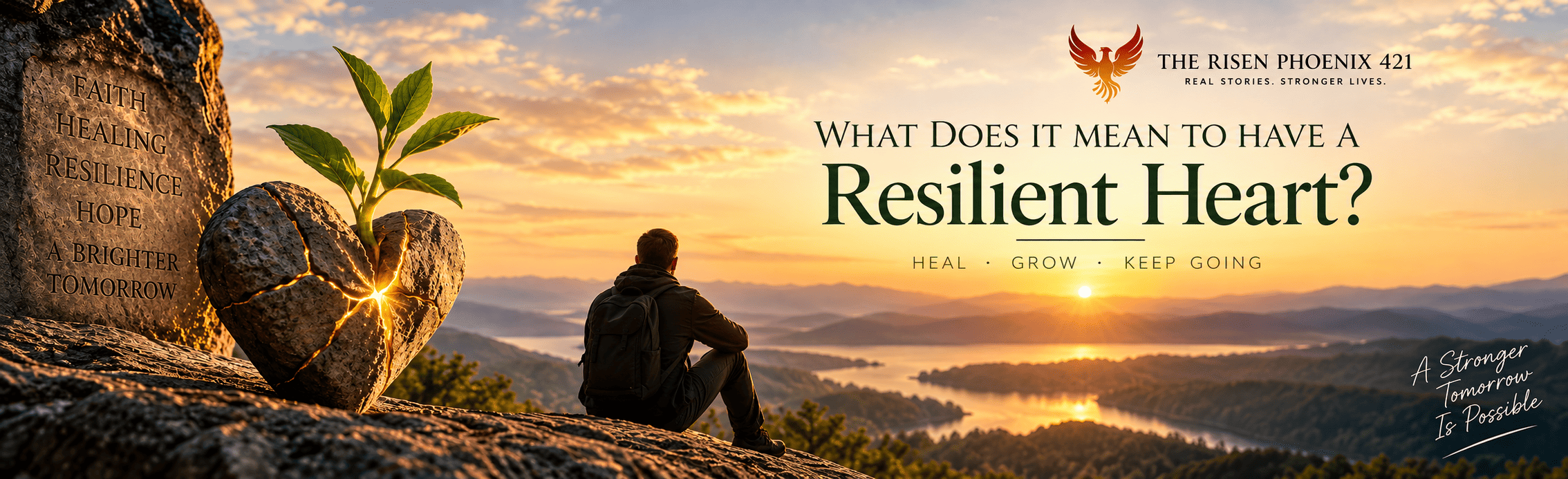
Life can change without warning. A health challenge, personal loss, relationship difficulty, career setback, or unexpected change can leave us questioning what comes next.
In moments like these, people often talk about being strong. But strength does not always mean having everything under control.
A resilient heart means facing hardship without losing your capacity for hope, growth, connection, and purpose. It does not mean avoiding pain or pretending that everything is fine. Instead, it means learning how to adapt, accept support, grow through experience, and continue moving forward when life takes an unexpected turn.
A resilient heart can be hurt and still heal. It can experience uncertainty and still hold onto hope. Most importantly, it understands that one difficult chapter does not have to define the entire story.
If you are new to the subject, you may also want to read our guide on what resilience is and why it is important in life.
What Is a Resilient Heart?
Resilience is commonly understood as the ability to adapt when facing challenging circumstances.
The American Psychological Association explains resilience as the process of adapting successfully to adversity through mental, emotional, and behavioral flexibility.
But what does that look like in everyday life?
It might mean adjusting your plans after something unexpected happens. It might mean asking someone for help when you normally prefer handling things alone. It can mean accepting that recovery takes time instead of expecting yourself to feel better immediately.
A resilient heart does not deny what happened.
It acknowledges the experience while refusing to believe that hardship has the final word.
A Resilient Heart Can Still Feel Pain
One of the biggest misconceptions about resilience is that resilient people do not struggle.
They do.
A person can be resilient and still feel sadness, fear, disappointment, frustration, or uncertainty. Strength does not require you to ignore difficult emotions.
In fact, allowing yourself to acknowledge what you are feeling can be an important part of moving forward.
There will be times when progress feels clear and other times when it seems much slower. You may have a good week followed by a difficult day.
That does not automatically mean you have lost your progress.
Healing rarely happens in a perfectly straight line.
A resilient heart permits itself to experience pain honestly while continuing to believe that growth is still possible.
Resilience Is About Adapting, Not Pretending
Life does not always give us control over what happens, but we often have some control over how we respond.
This is where adaptability becomes important.
Imagine working toward a goal for years and suddenly discovering that your original plan is no longer possible. Staying focused only on what should have happened can make it difficult to see the choices still available.
Eventually, resilience asks a different question:
What can I do from here?
Sometimes the answer is changing direction.
Sometimes it is slowing down.
Sometimes it is asking for help.
And sometimes it means taking one smaller step instead of trying to fix everything at once.
Adapting does not mean that the original dream did not matter. It means recognizing where you are now and deciding how you want to move forward.
For more practical guidance, read How to Build Resilience During Difficult Times.
Hope Is an Important Part of a Resilient Heart
Hope is sometimes confused with pretending everything will work out exactly as planned.
That is not what real hope looks like.
Hope does not say:
“Nothing is wrong.”
Hope says:
“This is difficult, but this may not be where my story ends.”
A resilient person can acknowledge reality while still allowing room for possibility.
You may not know how circumstances will change. You may not know exactly what the next chapter will look like.
But you can still believe that another chapter exists.
This idea of continuing through adversity is central to Jeffrey W. Lewings’ work and the message behind Resilient Heart.
Readers interested in those themes can learn more about Resilient Heart and the story behind the book.
Resilience Often Comes From Lived Experience
Resilience is not usually developed in one dramatic moment.
It grows over time.
Each difficult season can teach us something about ourselves. We learn which habits help us, which relationships support us, when we need to slow down, and when it is time to make a change.
Jeffrey W. Lewings’ perspective on resilience comes from more than theory.
His life experiences include facing major health challenges as a heart transplant survivor, serving as a Marine veteran, working in ministry, and serving others through social-services work. These experiences have shaped the way he writes about perseverance, faith, healing, leadership, and personal growth.
His story is a reminder that resilience does not necessarily mean returning to exactly who you were before hardship.
Sometimes resilience means becoming someone different because of what you have learned.
You can read more about Jeffrey W. Lewings and his journey.
A Resilient Heart Knows When to Ask for Help
Many people are taught to associate strength with independence.
But resilience does not mean doing everything alone.
Support can come from friends, family members, mentors, faith communities, counselors, or other trusted people.
Sometimes simply being able to talk honestly about what you are experiencing can make a difficult situation feel more manageable.
You do not always need someone to solve the problem.
Sometimes you need someone who will listen.
There may also be situations where professional support is appropriate. If emotional distress is significantly interfering with everyday life, speaking with a qualified health or mental-health professional can be a constructive step.
Asking for support is not a failure of resilience.
It can be an important part of it.
Faith and Meaning Can Provide Direction
For many people, faith becomes especially important during uncertain periods.
Difficult experiences often cause us to reconsider questions we may not normally stop to ask:
What matters most to me?
What do I believe?
Who do I want to become?
What relationships deserve more attention?
What do I want the next chapter of my life to represent?
Not every painful experience comes with an immediate explanation.
Sometimes there is no simple answer to why something happened.
But we can still decide how we respond to it.
Faith, service, family, community, creativity, and personal purpose can all provide a sense of direction when circumstances feel uncertain.
These ideas are deeply connected to the themes explored in Resilient Heart.
Everyday Resilience Is Often Quiet
When we hear the word resilience, we may imagine a dramatic comeback or life-changing success story.
But most resilience happens quietly.
It can look like getting up and handling your responsibilities after a difficult day.
It might mean returning to something you stopped believing you could do.
It can be forgiving yourself for a mistake.
Setting a healthier boundary.
Making an appointment you have been avoiding.
Reconnecting with someone.
Returning to your faith.
Trying again after disappointment.
These choices may seem small when they happen, but repeated over time, they can change the direction of a life.
You do not always need a breakthrough.
Sometimes you simply need the courage to make the next helpful decision.
A Resilient Heart Learns From the Past Without Living There
Our past experiences can teach us valuable lessons.
They may show us who supported us during difficult times, what choices we would make differently today, or what strengths we discovered when life demanded more from us.
Reflection becomes useful when it helps us move forward.
Ask yourself:
What did this experience teach me?
Maybe you learned that you need stronger boundaries.
Maybe you discovered that certain relationships matter more than you realized.
Maybe you learned to ask for help sooner.
Perhaps your priorities changed completely.
The past cannot be rewritten, but the way you carry it can change.
A resilient heart learns from yesterday without allowing yesterday to control every decision tomorrow.
How Do You Develop a More Resilient Heart?
There is no perfect formula for resilience, but there are meaningful habits that can help.
Start by being honest about what you are experiencing instead of pretending it does not affect you. Stay connected with trustworthy people rather than isolating yourself.
Focus your energy on things you can actually influence.
Take care of the basics: appropriate rest, regular meals, movement, and enough structure to keep your days grounded.
When a problem feels overwhelming, break it into smaller steps.
Instead of asking:
“How am I going to fix my entire life?”
Try asking:
“What is one useful thing I can do today?”
That change in perspective can make a difficult situation feel more manageable.
Most importantly, give yourself time.
Resilience is not about recovering faster than everyone else.
It is about continuing to grow in a way that is healthy and meaningful for you.
The Meaning Behind a Resilient Heart
The phrase resilient heart represents more than simply being strong.
It represents the ability to remain open to healing after being hurt.
To keep faith after uncertainty.
To find meaning after hardship.
And to keep moving forward when life looks very different from what you once expected.
Jeffrey W. Lewings explores these themes throughout Resilient Heart, drawing from a life shaped by adversity, faith, reflection, and transformation.
The message is not that hardship should be ignored.
It is that hardship does not necessarily have to become the final chapter.
Readers interested in going deeper can explore Resilient Heart or see what readers are saying.
Final Thoughts: What Does It Mean to Have a Resilient Heart?
A resilient heart is not a heart that has never been hurt.
It is a heart that continues to live, learn, connect, and hope after hardship.
It understands that being strong does not require pretending to be fearless. It recognizes when support is needed. It learns from the past without allowing the past to determine the future.
And even when the next step is uncertain, it remains willing to take it.
Sometimes resilience looks dramatic.
Other times, it is simply the quiet decision to say:
“I am still here, and I am going to keep going.”
To learn more about Jeffrey W. Lewings, Resilient Heart, or his work, contact The Risen Phoenix 421.
About the Author
Jeffrey W. Lewings is the author of Resilient Heart. Drawing from his experiences as a heart transplant survivor, Marine veteran, minister, and social-services professional, Jeffrey writes about resilience, faith, healing, leadership, and personal growth. His work encourages readers to face adversity with purpose, reflect on what difficult experiences can teach us, and continue moving forward with hope.